Sunday, 31 March 2013

FN F2000 assault rifle (Belgium)


Caliber: 5.56x45 mm NATO
Action: Gas operated, rotating bolt
Overall length: 694 mm
Barrel length: 400 mm
Weight: 3.6 kg empty, in standart configuration; 4.6 kg with 40mm grenade launcher
Magazine capacity: 30 rounds (any NATO / STANAG type magazines)

During the late 1980s and early 1990sfamous Belgian company FN Herstal began the search for its next entry into the assault rifle world. The aim this time was to produce a modern, modular weapon, and this ultimately resulted in the FN F2000 rifle, which was first displayed in public in 2001. The F2000 offers all of the most popular features of the modern assault rifle, such as a compact bullpup layout, completely ambidextrous handling, and a modular design with plenty of options and add-ons already available, which allow the rifle to be “tailored” for any particular mission or tactical situation. For example, for peacekeeping operations F2000 could be fitted with less-lethal M303 underbarrel module, which fires tear gas or marker projectiles using pre-compressed air. On the other hand, the F2000 could be fitted with various 40 mm FN EGLM grenade launchers and a proprietary computerized fire control system, instead of the standard low-magnification optical sights.So far FN F2000 rifle found only few buyers, including Armed forces of Sloveniaand Belgian Special operations forces. Nevertheless, it is one of most promising assault rifles on the market.
 Quite recently FN also introduced a civilian version of F2000, known as FS2000.It has a somewhat longer barrel and is limited to semi-automatic fire. Otherwise it is the same excellent weapon, with great ergonomics and 100% ambidexterity.
The F2000 rifle is a gas operated, rotating bolt, selective-fire weapon, featuring a polymer stock with a bull-pup layout. Itutilizes a short-stroke gas piston and a 7-lug rotating bolt which locks into the barrel extension. The unique feature of the F2000 rifle is its patented front ejection system: the spent cases, extracted from the chamber, travel from the rear part of the gun to the ejection port near the muzzle via a special ejection tube and fall out of the gun at the safe distance from the shooters' face. This is achieved using a special swinging guide, which enters the way of the closing bolt, and directs the spent case, which is held on the bolt face, to the ejection tube, while, at the same time, lower lugs of the bolt are stripping a fresh cartridge from the magazine. The cocking handle is mounted well forward on the left hand side, just above the fore grip, and it can easily be operated with the right hand when the gun is held left-handed. The selector switch is mounted at the bottom of the trigger guard. All of these features combine to make the F2000 the first genuinely ambidextrous bullpup, able to be used with equal ease by right and left handed shooters without requiring any adjustments. In its standard configuration, the F2000 is perfectly balanced around the pistol grip.
 The stock has built-in standard rails on the top of the weapon (for different sights and scopes etc) and a mounting point ahead of trigger guard, where additional modules may be installed (such as grenade launchers, non-lethal modules etc). In the basic configuration, the upper rail mount is fitted with a 1.6X magnification optical sight, and the lower mounting point is covered by a removable handguard. At the current time, the F2000 rifle may be upgraded, depending on the mission, with FN's 40 mm low-velocity grenade launcher (on the lower mount, instead of the handguard), or with M303 non-lethal module; other options are handguards with built-in laser pointers or flashlights. The standard low-magnification combat scope, which has a back-up open sights on its top cover, may be replaced by any other scope onPiatiny-style mount, or with FN's proprietary computerized fire control module with laser rangefinder, for both the rifle and 40 mm grenade launcher.

FN CAL assault rifle (Belgium)

FN CAL assault rifle (Belgium)


FN CAL assault rifle with fixed butt


Caliber: 5.56x45 mm
Action: Gas operated, rotating bolt
Overall length: 926 mm
Barrel length: 467 mm
Weight: 3.0 kg empty
Rate of fire: 850 rounds per minute
Magazine capacity: 20 or 30 rounds

The FN CAL ("Carabine Automatique Légère", or Light Automatic Carbine) was first demonstrated in 1967. It was an early attempt of the famous Belgian company Fabrique Nationale (FN) to produce an assault rifle chambered for then-new American 5.56mm small-bore, high-velocity cartridge. The FN CAL rifle was designed with mass production in mind, with extensive use of steel stampings and plastics. However, the production life of this rifle was relatively short, and only about 12 000 of FN CAL rifles were manufactured before FN closed the CAL production line in 1977 and switched to more promising design, known as FN FNC. Most of these rifles were sold in Latin America and Africa. The main problems, associated with FN CAL rifles, were complexity of manufacture of certain parts, insufficient reliability and somewhat complex maintenance procedures.
The FN CAL assault rifle is gas operated, select-fire weapon. It uses short-stroke gas piston, located above the barrel. The locking is achieved by rotating bolt with multiple radial lugs that engage the barrel extension. Receiver is made from steel stampings and assembled from two parts (upper and lower), hinged at the front. Trigger unit is equipped with 4-position safety / fire selector, and allows for single shots, 3-round bursts and full automatic fire. The charging handle is located on the right side of the receiver, and moves along with the bolt group when gun is fired. Rifle can be fitted with fixed plastic butt or side-folding metallic butt. Standard sights consist of front post and L-shaped rear sight with two apertures (for 250 and 400 meters range). The muzzle compensator / flash hider is shaped to accept rifle grenades; the US-made M203 grenade launcher can be fitted under the rifle, if required. Feed was from proprietary box magazines with 20- or 30-round capacity.

Thursday, 28 March 2013

Greatest Top ten Snipers in History


‘It was night and low visibility, but I saw a guy with an AK-47 lit up by the porch light in a doorway about 400 meters away. I watched him through the sights. He looked like just another Iraqi. I hit him low in the stomach and dropped him.’ – Specialist James Wilks, 25, from Fort Worth, Texas. Concealment is key to becoming a great sniper. Highly trained marksmen who can shoot accurately from incredible distances with specialized training in high-precision rifles. In addition, they are trained in camouflage, field craft, infiltration, reconnaissance and observation, making them perhaps the most feared military presence in a war. Below is my list of top ten snipers in history and some of the greatest shots ever fired.


10.Thomas Plunkett (died in 1851)
Was an Irish soldier in the British 95th Rifles. What makes him on of the greats is that he shot a very impressive French general, Auguste-Marie-François Colbert.
During the battle at Cacabelos during Monroes retreat in 1809, Plunkett, using a Baker Rifle, shot the French general at a range of about 600 meters. Giving the incredible inaccuracy of rifles in the early 19th century, this was either a very impressive feat, or one hell of a fluke. Well Plunkett not wanting his army buddies to think he was a bit lucky decided to take the shot again before returning to his line. So he reloaded his gun and took aim once again this time at the trumpet major who had come to the generals aid. When this shot also hit its intended target, proving that Plunkett is just one badass marksman, he looked back to his line to see the impressed faces of the others in the 95th Rifles.
Just for comparison the British soldiers were all armed with ‘Brown Bess muskets’ and trained to shoot into a body of men at 50 meters. Plunkett did 12 times that distance. Twice.


9. Sgt Grace (4th Georgia Infantry )
The date was May 9th 1864, when Sgt Grace, a Confederate sniper, achieved what was considered to be an incredible shot at the time, and what is definitely the most ironic demise of a target in history. It was during the battle of Spotsylvania when Grace took aim with his British Whitworth Rifle. His target was General John Sedgwick (pictured above) and the distance was 1,000 yards. An extremely long distance for the time. During the beginning of the skirmish, the confederate sharpshooters were causing Sedgwick’s men to duck for cover. Sedgwick refused to duck and was quoted saying “What? Men dodging this way for single bullets? What will you do when they open fire along the whole line? I am ashamed of you. They couldn’t hit Elephants at this distance.” His men persisted in taking cover. He Repeated “They couldn’t hit elephants at this distance” Seconds Later Grace’s shot hits Sedgwick just under his left eye.
I swear you couldn’t write it. Sedgwick was the highest ranking Union casualty in the civil war and upon hearing his death Lt. Gen. Ulysses S. Grant repeatedly asked “Is he really dead”.


8. Charles ‘Chuck’ Mawhinney (1949)

103 Confirmed Kills
Was an avid hunter as a kid and joined the Marines in 1967. He served in the U.S. Marine Corps during Vietnam and holds the record for number of confirmed kills for Marine snipers, exceeding that of legendary Marine sniper Carlos Hathcock. In just 16 months he killed 103 enemies and another 216 kills were listed as probable’s by the military, only because it was too risky at the time to search the bodies for documents. When he left the Marines he told no-one of his of his role during the conflict and only a few fellow Marines knew of his assignments. It was nearly 20 years before somebody wrote a book detailing his amazing skills as a sniper. Mawhinney came out of anonymity because of this and became a lecturer in sniper schools. He was once quoted saying “it was the ultimate hunting trip: a man hunting another man who was hunting me. Don’t talk to me about hunting lions or elephants; they don’t fight back with rifles and scopes. I just loved it. I ate it up.”
A routinely deadly shot from distances between 300 – 800 yards, Mawhinney had confirmed kills of over 1000 yards, making him one of the greatest snipers of the Vietnam war.

7.Rob Furlong
A former corporal of the Canadian Forces, he holds the record for the longest confirmed sniper kill in history at 1.51 miles or 2,430 metres. That’s the length of about 26 football pitches.
This amazing feat occurred in 2002, when he was involved in Operation Anaconda. His Sniper Team consisted of 2 Corporals and 3 Master Corporals. When a three man Al-Qaeda weapons team moved into a mountainside position he took aim. Furlong was armed with a .50-caliber McMillan Brothers Tac-50 Rifle and loaded with A-MAX very low drag bullets. He fired and missed. His second shot hit the enemies knapsack on his back. He had already fired his third shot by the time the second hit, but now the enemy knew he was under attack. The airtime for each bullet was about 3 seconds due to the immense distance, enough time for an enemy to take cover. However the dumbfounded militant realised what was happening just in time to take the third shot in the chest.


6.Vasily Zaytsev (March 23, 1915 – December 15, 1991)
242 Confirmed Kills
Zaytsev is probably the best known Sniper in history thanks to the movie ‘Enemy At The Gates’. It is a great film and I wish I could say it was all true. However the truth only goes as far as the battle of Stalingrad. There was no Nazi Counter-Sniper Specialist in real life. Well not to the extent of the film. Here’s the truth. Zaytsev was born in Yeleninskoye and grew up in the Ural Mountains. His surname means ‘hare‘. Before Stalingrad, he served as a clerk in the Soviet Navy But after reading about the conflict in the city he volunteered for the front line. he served in the 1047th Rifle Regiment. Zaytsev ran a sniper school in the Metiz factory. The cadets he trained were called Zaichata, meaning ‘Leverets’ (Baby Hares). This was the start of the sniper movement in the 62nd army. It is estimated that the snipers he trained killed more than 3,000 enemy soldiers
Zaytsev himself made 242 confirmed kills between October 1942 and January 1943, but the real number is probably closer to 500. I know I said there was no counter-sniper, but there was Erwin Kónig. Was alleged to be a highly skilled Wehrmacht sniper. Zaytsev claimed in his memoirs that the duel took place over a period of three days in the ruins of Stalingrad. Details of what actually happened are sketchy, but by the end of the three day period Zaytsev had killed the sniper and claimed his scope to be his most prized trophy. For him to make this his most prized trophy means that this person he killed must have been almost as good as Zaytsev himself.


5.Lyudmila Pavlichenko (July 12, 1916 – October 10, 1974)
309 Confirmed Kills
In June 1941, Pavlichenko was 24 and Nazi Germany were invading the Soviet Union. She was among the first volunteers and asked to join the infantry. she was assigned to the Red Armies 25th infantry Division. From there she became one of 2000 female snipers of the soviet.
Her first 2 kills were made near Belyayevka using a Mosin-Nagant bolt action rifle with a P.E. 4-power scope. The first action she saw was during the conflict in Odessa. She was there for 2 and a half months and notched 187 kills. When they were forced to relocate, she spent the next 8 months fighting in Sevastopol on the Crimean Peninsula. There she recorded 257 kills and for this feat she was cited by the Southern Army Council. Pavlichenkos’ total confirmed kills during WW2 was 309. 36 of those were enemy snipers.


4.Corporal Francis Pegahmagabow (March 9, 1891 – August 5, 1952)

378 Confirmed kills
300+ Captures
Three times awarded the military medal and twice seriously wounded, he was an expert marksman and scout, credited with 378 German kills and capturing 300+ more. He was an Ojibwa warrior with the Canadians in battles like those at mount sorrel. As if killing nearly 400 Germans wasn’t enough, he was also awarded medals for running messages through very heavy enemy fire, for directing a crucial relief effort when his commanding officer was incapacitated and for running through enemy fire to get more ammo when his unit was running low.
Though a hero among his fellow soldier, he was virtually forgotten once he returned home to Canada. Regardless he was one of the most affective snipers of world war 1.


3.Adelbert F. Waldron (March 14, 1933 – October 18, 1995)
109 confirmed kills
He holds the record for the highest number of confirmed kills for any American sniper in history. However it is not just his impressive kill record that makes him one of the best, but also his incredible accuracy.
This excerpt from ‘Inside the Crosshairs: Snipers in Vietnam’ by Col. Michael Lee Lanning, describes just what I’m talking about:
“One afternoon he was riding along the Mekong River on a Tango boat when an enemy sniper on shore pecked away at the boat. While everyone else on board strained to find the antagonist, who was firing from the shoreline over 900 meters away, Sergeant Waldron took up his sniper rifle and picked off the Vietcong out of the top of a coconut tree with one shot (this from a moving platform). Such was the capability of our best sniper.” Nuff Said.
If there was a scale of difficulty for shots like these, it would be next to impossible to beat. well lets try to do that anyway.
Here’s ‘white feather’….


2.Carlos Norman Hathcock II (May 20, 1942 – February 23, 1999


Nicknamed *Xa Thu Long Trang* (‘White Feather Sniper’)
93 Confirmed kills
Hathcock has one of the most impressive mission records of any sniper in the Marine corps. Lets forget about the dozens of shooting championships he won, during the Vietnam war he amassed 93 confirmed kills. The Vietnam army put a $30,000 bounty on his life for killing so many of their men. Rewards put on U.S. snipers by the NVA (North Vietnamese Army) typically amounted to….say $8.
It was Hathcock who fired the most famous shot in sniper history. He fired a round, over a very long distance, which went through the scope of an enemy sniper, hit him in the eye, and killed him. Hathcock and Roland Burke his spotter were stalking the enemy sniper, (which had already killed several Marines) which they believed was sent to kill him specifically. When Hathcock saw a flash of light reflecting off the enemies scope he fired at it in a split second pulling off one of the most precise shots in history. Hathcock reasoned that the only way that this was possible, would have been if both snipers were aiming at each others scopes at the same time, and he fired first. However, although the distance was never confirmed, Hathcock knew that because of the flight time, it would have been easy for both snipers to kill each other. The white feather was synonymous with Hathcock (He kept one in his hat) and he removed it only once for a mission. Keep in mind that he volunteered for this mission, but he had to crawl over 1500 yards of enemy territory to shoot an NVA commanding general. Information wasn’t sent until he was on-route. (He volunteered for a mission he knew nothing about) It took 4 days and 3 nights without sleep of inch-by-inch crawling. One enemy soldier almost stepped on him as he laid camouflaged in a meadow. At another point he was nearly bitten by a viper, he didn’t flinch. He finally got into position and waited for the general. When he arrived Hathcock was ready. He fired one round and hit the general through the chest killing him. The soldiers started a search for the sniper and Hathcock had to crawl back to avoid detection. They never caught him. Nerves of steel.


1.Simo Häyhä (December 17, 1905 – April 1, 2002 )
Nicknamed ‘The White Death’
705 confirmed kills (505 with rifle, 200 with submachine gun)
Was a Finnish soldier who, using an iron sighted bolt action rifle, amassed the highest recorded confirmed kills as a sniper in any war…ever!!
Häyhä was born in the municipality of Rautjärvi near the present-day border of Finland and Russia, and started his military service in 1925. His duties as a sniper began during the ‘winter war’ (1939-1940) between Russia and Finland. During the conflict Häyhä endured freezing temperatures up to -40 degrees Celsius. In less than 100 days he was credited with 505 confirmed kills, 542 if including unconfirmed kills, however the unofficial frontline figures from the battlefield places the number of sniper kills at over 800. Besides his sniper kills he was also credited with 200 from a Suomi KP/31 Submachine gun, topping off his total confirmed kills at 705.
How Häyhä did all this was amazing. He was basically on his own all day, in the snow, shooting Russians, for 3 months straight. Of course when the Russians caught wind that a shit load of soldiers were being killed, they thought ‘well this is war, there’s bound to be casualties’. But when the generals were told that it was one man with a rifle they decided to take a bit of action. first they sent in a counter-sniper. When his body was returned they decided to send in a team of counter-snipers. When they didn’t come back at all they sent in a whole goddamn battalion. They took casualties and couldn’t find him. Eventually they ordered an artillery strike, but to no avail. You see Häyhä was clever, and this was his neck of the woods. He dressed completely in white camouflage. He used a smaller rifle to suit his smaller frame (being 5ft3) increasing his accuracy. he used an iron sight to present the smallest possible target (a scoped sight would require the sniper to raise his head for sighting). He compacted the snow in front of the barrel, so as not to disturb it when he shot thus revealing his position. He also kept snow in his mouth so his breath did not condense and reveal where his was. Eventually however his was shot in the jaw by a stray bullet during combat on March 6 1940. He was picked up by his own soldiers who said half his head was missing. He didn’t die however and regained consciousness on the 13th, the day peace was declared.
Once again total kills…. 505 sniper + 200 submachine = 705 total Confirmed Kills…all in less that 100 days.


By: listverse.com


Wednesday, 27 March 2013

FN CAL assault rifle (Belgium)


Caliber: 5.56x45 mm
Action: Gas operated, rotating bolt
Overall length: 926 mm
Barrel length: 467 mm
Weight: 3.0 kg empty
Rate of fire: 850 rounds per minute
Magazine capacity: 20 or 30 rounds

The FN CAL ("Carabine Automatique Légère", or Light Automatic Carbine) was first demonstrated in 1967. It was an early attempt of the famous Belgian company Fabrique Nationale (FN) to produce an assault rifle chambered for then-new American 5.56mm small-bore, high-velocity cartridge. The FN CAL rifle was designed with mass production in mind, with extensive use of steel stampings and plastics. However, the production life of this rifle was relatively short, and only about 12 000 of FN CAL rifles were manufactured before FN closed the CAL production line in 1977 and switched to more promising design, known as FN FNC. Most of these rifles were sold in Latin America and Africa. The main problems, associated with FN CAL rifles, were complexity of manufacture of certain parts, insufficient reliability and somewhat complex maintenance procedures.
The FN CAL assault rifle is gas operated, select-fire weapon. It uses short-stroke gas piston, located above the barrel. The locking is achieved by rotating bolt with multiple radial lugs that engage the barrel extension. Receiver is made from steel stampings and assembled from two parts (upper and lower), hinged at the front. Trigger unit is equipped with 4-position safety / fire selector, and allows for single shots, 3-round bursts and full automatic fire. The charging handle is located on the right side of the receiver, and moves along with the bolt group when gun is fired. Rifle can be fitted with fixed plastic butt or side-folding metallic butt. Standard sights consist of front post and L-shaped rear sight with two apertures (for 250 and 400 meters range). The muzzle compensator / flash hider is shaped to accept rifle grenades; the US-made M203 grenade launcher can be fitted under the rifle, if required. Feed was from proprietary box magazines with 20- or 30-round capacity.


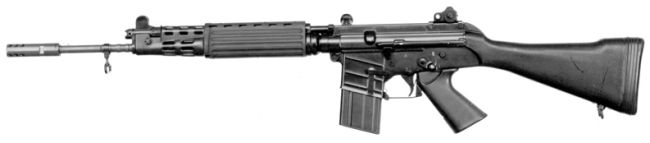
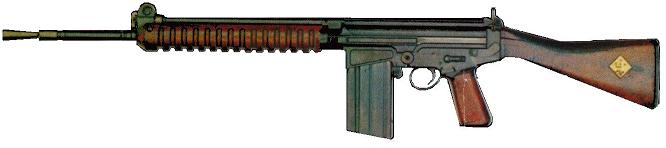
FN FAL assault rifle (Belgium)

Caliber : 7,62mm NATO (7.62x51)
Action: Gas operated, tilting breechblock, select-fire or semi-auto only
Length: 1100 mm (990 / 736 mm for "Para" model)
Barrel length: 533 mm (431 mm for "Para" model)
Weight: 4.45 kg empty (3.77 kg empty for "Para" models)
Magazine capacity: 20 rounds (30 rounds for heavy barreled SAW versions)
Rate of fire: 650-700 rounds per minute

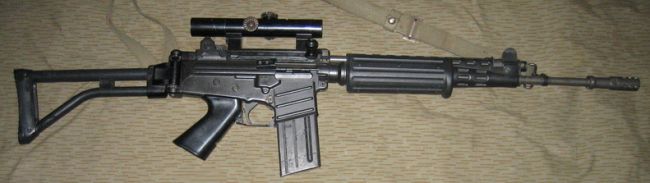
The FN FAL (Fusil Automatique Leger - Light Automatic Rifle) is one of the most famous and widespread military rifle designs of the XX century. Developed by the Belgian Fabrique Nationale company, it was used by some 70 or even more countries, and was manufactured in at least 10 countries. At the present time the service days of the most FAL rifles are gone, but it is still used in some parts of the world. The history of the FAL began circa 1946, when FN began to develop a new assault rifle, chambered for German 7.92x33mm Kurz intermediate cartridge. The design team was lead by Dieudonne Saive, who at the same time worked at the battle rifle, chambered for "old time" full-power rifle cartridges, which latter became the SAFN-49. It is not thus surprising that both rifles are mechanically quite similar. In the late 1940s Belgians joined the Britain and selected a British .280 (7x43mm) intermediate cartridge for further development. In 1950 both Belgian FAL prototype and British EM-2 bullpup assault rifles were tested by US Army. The FAL prototype greatly impressed the Americans, but the idea of the intermediate cartridge was at that moment incomprehensible for them, and USA insisted on adoption of their full-power T65 cartridge as a NATO standard in 1953-1954. Preparing for this adoption, FN redesigned their rifle for the newest T65 / 7.62x51mm NATO ammunition, and first 7.62mm FALs were ready in 1953. Belgium was not the the first country to adopt their own rifle in 1956. Probably the first one was a Canada, adopting their slightly modified version of FAL as C1 in 1955. Canadians set to produce C1 and heavy barreled C2 squad automatic rifles at their own Canadian Arsenal factory. Britain followed the suit and adopted the FAL in 1957 as an L1A1 SLR (Self-loading rifle), often issued with 4X SUIT optical scopes. Britain also produced their own rifles at the RSAF Enfield and BSA factories. Austria adopted the FAL in 1958 as a Stg.58 and manufactured their rifles at Steyr arms factory. Various versions of FAL were also adopted by the Brazil, Turkey, Australia, Israel, South Africa, West Germany and many other countries. The success of the FAL could be even greater if Belgians would sell the license to W.Germany, which really liked to produce the FAL as a G1 rifle, but Belgians rejected the request. Germany purchased the license for Spanish CETME rifle and as a result of this H&K G3 rifle became probably the most notable rival to FAL.

During the time, FAL was built in numerous versions, with different furniture, sights, barrel lengths etc. There are, however, four basic configurations of FAL rifle: FAL 50.00, or simply FAL, with fixed buttstock and standard barrel; FAL 50.63 or FAL "Para", with folding skeleton butt and short barrel; FAL 50.64 with folding skeleton butt of "Para" model and standard length barrel; and the FAL 50.41, also known as FAL Hbar or FALO - a heavy barreled model which was intended primary as a light support weapon. There are also two major patterns of FALs around the globe: "metric" and "inch" FALs. As the names implied, these were built in countries with metric or imperial (inch) measure systems. These patterns are slightly different in some dimensions, and magazines of metric and inch pattern sometimes could not be interchanged. Most "inch" pattern FALs were made in British Commonwealth countries (UK, Canada, Australia) and have had folding cocking handles and were mostly limited to semi-automatic fire only (except for Hbar versions like C2). Most "metric" pattern rifles had non-folding cocking handles and may or may not have select-fire capability, but as with other light select-fire weapons chambered for 7.62x51mm NATO round, the controllability of the full auto fire is disappointing and shots spread in burst is extremely wide. But, regardless of this, the FAL is one of the best so known "battle rifles", reliable, comfortable and accurate. It is somewhat sensitive to fine sand and dust but otherwise is a great weapon.

The only countries still producing the FAL rifles until the present time are the Brazil and, most surprisingly, the USA. Brazil adopted the FAL under the name LAR and manufactured it at the IMBEL facilities. The USA produced a small amount of FALs as the T-48 at H&R factory in early 1950s for Army trials, but at the present time a number of private US Companies is manufacturing various versions of FAL rifles using either surplus parts kits or newly manufactured parts. Most of these rifles are limited to semi-auto only and are available for civilian users. Probably most notable US manufacturer of FAL modifications is the DS Arms company, which produced its rifles under the name of DSA-58.

The FN FAL is a gas operated, selective fire or semi-automatic only, magazine fed rifle. It uses short piston stroke gas system with gas piston located above the barrel and having its own return spring. After the shot is fired, the gas piston makes a quick tap to the bolt carrier and then returns back, and the rest of the reloading cycle is commenced by the inertia of bolt group. The gas system is fitted with gas regulator so it could be easily adjusted for various environment conditions, or cut off completely so rifle grenades could be safely launched from the barrel. The locking system uses bolt carrier with separate bolt that locks the barrel by tipping its rear part into the recess in the receiver floor. The receivers initially were machined from the forged steel blocks, and in 1973 FN began to manufacture investment cast receivers to decrease production costs. Many manufactures, however, stuck to the machined receivers. The trigger housing with pistol grip is hinged to the receiver behind the magazine well and could be swung down to open action for maintenance and disassembly. The recoil spring is housed in the butt of the rifle in fixed butt configurations or in the receiver cover in folding butt configurations, so the folding butt versions require a slightly different bolt carrier, receiver cover and a recoils spring. The cocking handle is located at the left side of the receiver and does not move when gun is fired. It could be folding or non-folding, depending on the country of origin. The safety - fire selector switch is located at the trigger housing, above the triggerguard. It can have two (on semi-automatic) or three (on select-fire rifles) positions. The firing mechanism is hammer fired and use single sear for both semi-automatic or full automatic fire. Barrel is equipped with long flash hider which also serves as a rifle grenade launcher. Design of flash hider may differs slightly from country to country. The furniture of the FAL also can differ - it could be made from wood, plastic of various colors or metal (folding buttstocks, metallic handguards on some models). Some models, such as Austrian Stg.58 or Brazilian LAR were fitted with light bipods as a standard. Almost all heavy barrel versions also were fitted with bipods of various design. Sights usually are of hooded post front and adjustable diopter rear types, but can differ in details and markings. Almost all FAL rifles are equipped with sling swivels and most of rifles are fitted with bayonet lugs.


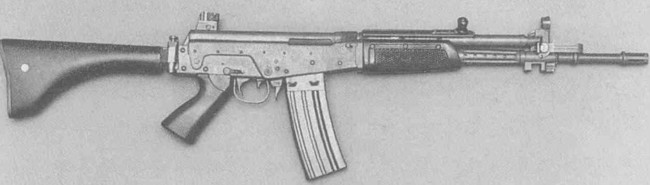
FARA 83 assault rifle (Argentina)

Caliber: 5,56x45mm
Action: Gas operated, rotating bolt
Overall length: 1000 mm (745 mm with butt folded)
Barrel length: 452 mm
Weight: 3,95 kg empty
Rate of fire: 750 rounds per minute
Magazine capacity: 30 rounds

FARA 83 assault rifle was developed at Argentinean small arms factory FabricaMilitar de Armas Portatiles Domingo Matheu by 1983. About 1200 rifles were produced by 1986, but further manufacture was ceased because of budgetary limitations.
FARA 83 assault rifle is gas operated weapon that uses rotary bolt locking system.Receiver is largely made from steel stampings, with trigger unit hinged to it behind the magazine housing.  The gas system was fitted with cut-off valve which permitted launching of rifle grenades using special blanc ammunition.Buttstock was made from polymer and could be folded to the side to safe the space.


By:world.guns.ru

AICW - Advanced Infantry Combat Weapon (Australia)

Caliber: 5.56x45mm NATO + 40mm
Action: Gas operated, rotating bolt + Metal Storm patented stacked-projectile caseless
Overall length: 738 mm
Barrel length: n/a
Weigth: 6.48 kg unloaded, w/o sight; 7.85 kg loaded w/o sight (30 5.56mm + 3 40mm rounds); 9.9-9.9 kg loaded w. electronic sight
Rate of fire: 650 rounds per minute (for 5.56mm barrel)
Capacity: 30 rounds (5.56mm) magazine plus 3 40mm rounds in the G/L barrel

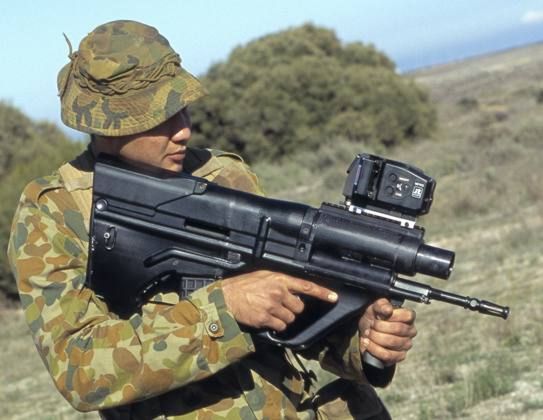
The AICW (Advanced Infantry Combat Weapon) is a joint development of the Australian DSTO (Government operated Defence Science and Technology Organisation), and private companies Metal Storm and Tenix Defence. This development has been carried out since the turn of 21st century, closely following the concept of the American XM29 OICW system. Overall, AICW represents the modular weapon system that combines the 5.56mm rifle/carbine copmponent as a host (basic) platform with 40mm multi-shot grenade launcher (G/L) module and multi-purpose electro-optical sighting system, which can be used to fire either rifle or G/L component, and also can provide recon data to external "consumers" such as tactical computers.
The host rifle component of the AICW is the updated Australian-made F88 rifle, which is a license-built Steyr AUG.However, the basic F88 rifle has been extensively modified to accept other elements of the system - for example, receiver has been upgraded to receive the G/L module at the top, and the buttstock has been enlarged to accomodate G/L electronic fire contol module. Other changes include modification to the safety and trigger arrangements - AICW system has a single trigger for both weapon components (5.56 and 40mm), and a three position (safe - rifle - G/L) safety/selector switch at the side of the pistol grip.
The most interesting part of the AICW weapon is the multi-shot Metal Storm 40mm grenade launcher, which looks like a single 40mm G/L barrel but contains three 40mm projectiles stacked one behind the another. These projectiles are launched using the electric ignition impulses, provided by the fire control module built into the buttstock of the host rifle. Since the muzzle velocity of these projectiles is slightly more than usual for 40mm handheld G/L (95m/s instead of 75m/s), host rifle incorporates the recoil reduction buffer, that allows the Metal Storm G/L barrel to recoil against the spring, decreasing the peak recoil impulse.
The top of the receiver hosts the multi-role sights of various type and make. At the AICW VX3 live fire demonstartions that took place in the summer of 2005, AICW prototypes were displayed with ITL Viper multi-purpose rifle sight (that incorporates laser range-finder and digital compas), or with Vinghog Vingsight Fire Control System. At the present time (late 2005) AICW prototypes have not yet fired 40mm grenades with live warheads, nor incorporated an airburst facility. However, it is stated that it is possible to easily adapt most of the existing 40mm grenade warheads to the Metal Storm technology, including air-bursting grenades that are now in development in several countries.
At the present time AICW weapons are available only as the "3rd generation technology demonstartors", that completed first live-fire trials (as a complete system) in the summer of 2005. Current Australian MOD plans state that ADF may start to purchase AICW systems in around 2010-2012.